Mysore
Princely States

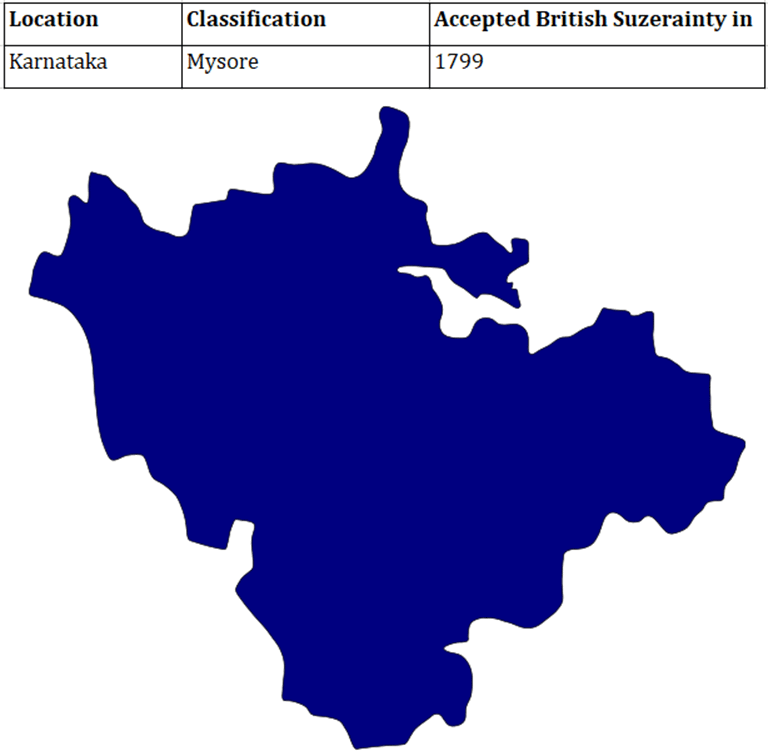

Mysore's royal family traces origin to two Kshatriya Yadava brothers Vijaya and Krishna who left Dwaraka in search for a place to establish themselves. When they reached Hadinad in Karnataka, they learnt that the chief of the area wandered away after he became mad. The neighbour ruling Karugahalli took advantage of it and coerced the kingdom to give the hand of the heir to the throne in marriage. However, the brothers took the side of Hadinad and went as a part of the banquet to kill the chief and his chief officers. After that, they marched on Karugahalli, surprised it and returned back in triumph. The princess of Hadinad willingly married Vijaya who took the title Wodeyar, took the locally dominant Lingayat religion and ruled Karugahalli and Hadinad. The title Wodeyar is a plural of Odeya – a Kannada honorific for lord. A second version tells that two Chandravamsa Princes from Dwaraka came to visit the family god Narayana at Melukote and settled in Mahishapura or Mysore. They became the progenitors of the Mysore line. This clearly indicates that the Karugahalli–Hadinad episode is a latter interpolation. No written records of the family exist before Chamaraja III.
Timmaraja gained the title Antembara Ganda. Chamaraja III partitioned the estate between his three sons – Timmaraja or Appanna got Hemmanahalli, Krishnaraja got Kembala and Chamaraja IV got Mysore. The elder brothers died heirless and Chamaraja's line assumed control of the complete estate in due course of time.
Chamaraja IV, known as Bola or bald after he was struck by a lightning, defeated Remati Venkata, a general of Rama Raja and taking advantage of the defeat at Talikota, refused to pay the tribute. Further on he annexed Bangalore tract into his estate. The Vijayanagara Viceroy of Srirangapatna tried to seize Chamaraja but alerted, he fled and didn't bother to heed the orders of the government. Literary tradition states that he is succeeded by his younger son Chama Raja and was deposed in two years due to his incapability by the nobles. His elder brother Raja Wodeyar ascended the throne in his place. Soon after he took charge of Mysore, he attacked Srirangapatna, defeated the Vijayanagara viceroy Tirumala somewhere after 1591 and Vijayanagara had to formalize his control in 1612 – clearly indicating that they needed a strong hand to stable the ship when the kingdom was under constant attacks.
The traditional story goes that due to some incurable disease, Tirumala came down to Talakadu to pray at the temple of Lord Vaidyeswara but hearing of his impending death, his wife Rani Alamelamma handed over the charge of Srirangapatna to Raja Wodeyar who seized the place for him and not just that, desirous of possessing the Rani's jewels and personal wealth, he chased her with a troop. Unable to escape him, she threw her jewels into Kaveri at Malangi and drowned herself in the river uttering the curse,
Talkādu Maralaāgi, Mālingi maduvaāgi,
Mysuru dhorege makkalagade hōgali!
May Talakadu become desert land, Malangi become a whirlpool, And Mysore Kings bear no heirs!
